
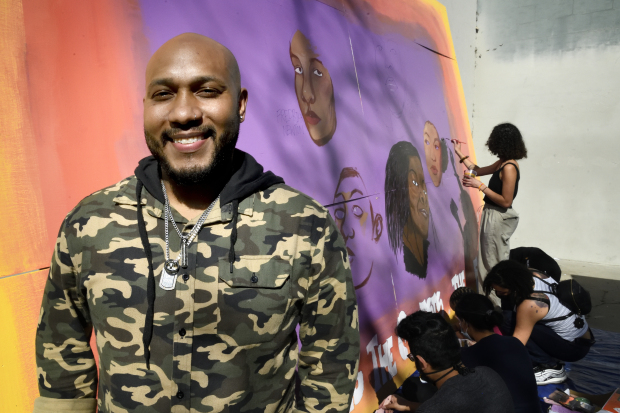
TEAM WORK When making a mural dedicated to community leaders, HERO Tent enlisted the community. Photo Credit: Greg Ramar
Rays of South Bay winter sunshine illuminated Backesto Park this past weekend as activists and members of the community gathered to celebrate the last weekend of Black History Month. With singing, dancing, food and art, the event was a clear demonstration of what Kiana Simmons calls “Black joy.”
Simmons and the San Jose-based racial justice nonprofit she co-founded, HERO Tent, host such events regularly. Dubbed “Art in the Park,” they are family-friendly events showcasing business owners, artists and musicians of color along with plenty of sidewalk chalk for the children.
Central to this event, as opposed to those in the past, was the presence of a mural of six faces being painted and serving as backdrop to the performers.
Volunteers with HERO Tent worked together to decide the message portrayed and the people depicted in the mural. Esha Shah, a HERO Tent volunteer, took their ideas and designed the layout.
“We decided we wanted to [depict] Black women and Black women only, and we particularly picked [members of] the Black Panther Party,” Shah says. “It’s inspiring and calling back to the work that these women did.”
“It’s an ode to Black Women organizers,” says Simmons.
The six women depicted are Angela Davis, Afeni Shakur, Assata Shakur, Elaine Brown, Fredrika Newton and Kathleen Cleaver. Along with the mural, HERO Tent also produced a pamphlet—or “zine,” as inspired by the Black Panther Party—detailing the legacies of each of these women, many of whom were arrested at one point during their activism. Notably, Assata Shakur was involved in a 1973 shoot out with New Jersey state troopers in which a fellow activist and an officer were both killed. Shakur denied brandishing a weapon, but she was convicted of murder. In 1979, she fled to Cuba, where she was granted asylum and remains a fugitive to this day.
Shah, a young Indian raised in San Jose, felt connected to the Black Panthers after learning about how they inspired the Dalit Panthers, a similar organization founded in 1972 to combat caste discrimation in India. “That’s a central component to organizing,” she says. “Making people feel like they have a community when everyone else is telling them that they don’t.”
Part of the problem, she says, is America’s narrative of competition.
“Historically, communities of color have been pitted against each other and we’ve participated in those structures willingly,” she continued. “It’s important to hear each other’s struggles and be able to understand our own struggles through them and engage in solidarity rather than competition.”
That vision was truly realized as HERO Tent invited anyone in attendance to participate in the creation of the mural. People of many walks of life stood side by side, doing so throughout the day on Sunday.
A “community-based” mural was important to Simmons, who says she believes in making all HERO Tent events and activities accessible.
“I wanted everyone to leave their mark on it so that they are a part of it,” she says. “A lot of youth participated and it was really nice to see that. They even scribbled a little bit,” she recounts, laughing. “But, we’re going to keep it in!”
In addition to members of the community, HERO Tent also commissioned the help of three Black artists to oversee and execute the majority of the painting.
One of those artists, Ellis Stephens, was born and raised on the east side of San Jose. He was excited to work on a mural of “beautiful, powerful Black women.” Having read Assata’s memoir, he says he found her story “amazing,” her ideologies “super powerful to the Black community.”
“I’ve always wanted to put my stamp on something and be part of something that would be everlasting in the community. It means a lot to be out here,” he notes. He hopes his daughter can find inspiration in the mural, especially knowing that her father helped create it.
HERO Tent originally intended for the mural to be painted on a wall at the park, but Simmons says the approach they took, painting on sheets of plywood nailed to a frame, enables them to have a “traveling mural.”
“We want to be able to [take it] to different spaces,” she says, hoping to further the idea of community ownership over the mural. “I think it could be at churches, it could be at other parks, it could be at restaurants, at bars. It could even be at city hall once or twice. Black joy is resilient, it’s powerful, it’s revolutionary and it deserves to be shared.”


You must log in to post a comment.